|
Gift
of the Wind
Aboard Höküle'a on her miraculous journey to Rapa Nui
By Sam Low
First Finalist, Society of Professional Journalists, Hawaii Chapter,
Feature Writing - Long Form, Hana Hou magazine, 2001; Kahili Award,
Hawaii Visitors Bureau award for best article celebrating Hawaiian
culture, Hana Hou magazine, 2000
Originally published in Hana Hou Magazine
All
Photographs by Sam Low
By the end of 1995,
Höküle'a had sailed almost 85,000 miles since her launching twenty years
earlier. She had voyaged between Hawai'i and Tahiti five times, and between
Tahiti and New Zealand twice. She had visited the Marquesas, Tuamotus,
Cooks, Australs and Samoa. She had been to all the corners of the great
expanse of the Pacific Ocean known as the Polynesian Triangle - all, that
is, except one: the eastern corner, which is occupied by a tiny island
all alone in a vast, empty sea. Europeans know it as Easter Island, but
throughout Polynesia it is called Rapa Nui. "We have never sailed to Rapa
Nui not because we didn't want to," Polynesian Voyaging Society director
and head navigator Nainoa Thompson once said. "But because we didn't think
we could do it."
In 1999, however, he decided to try.
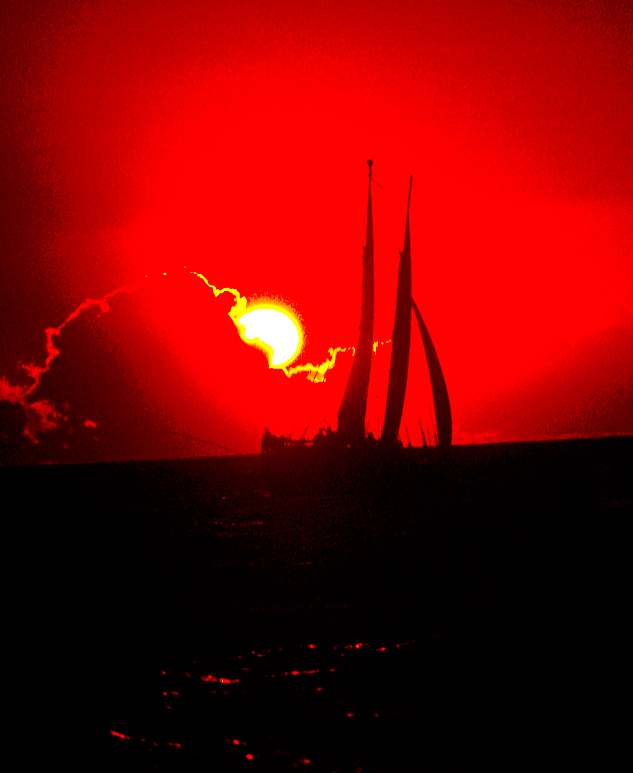 The trip, as Nainoa envisioned it, would involve sailing directly into
the prevailing southeast tradewinds from the nearest major landfall, the
island of Mangareva far to the west. This, after all, was the route that
ancient Polynesian navigators themselves may have followed to arrive at
Rapa Nui. To recreate this epic journey, Höküle'a would almost certainly
have to tack into constant headwinds, extending the distance she would
need to travel from 1,500 straight-line miles to more than 4,000 zigzagging
ones. And every mile would be cold and wet, severely testing the crew's
endurance. Adding to the difficulty would be the fact that Rapa Nui is
a tiny target, only thirteen miles wide and 1,600 feet high, so Höküle'a
would have sail within about thirty miles of the island for the crew to
spot it. The odds against finding this mythic landfall were daunting indeed.
Nainoa and the two other experienced wayfinders on board - Bruce Blankenfeld
and Chad Baybayan - would be guiding the canoe as their ancestors had
done, without the benefit of charts or instruments, and a navigational
error of only a degree of latitude would cause Höküle'a to sail past the
island. If that happened, the next landfall would be South America - 2,000
miles away.
The trip, as Nainoa envisioned it, would involve sailing directly into
the prevailing southeast tradewinds from the nearest major landfall, the
island of Mangareva far to the west. This, after all, was the route that
ancient Polynesian navigators themselves may have followed to arrive at
Rapa Nui. To recreate this epic journey, Höküle'a would almost certainly
have to tack into constant headwinds, extending the distance she would
need to travel from 1,500 straight-line miles to more than 4,000 zigzagging
ones. And every mile would be cold and wet, severely testing the crew's
endurance. Adding to the difficulty would be the fact that Rapa Nui is
a tiny target, only thirteen miles wide and 1,600 feet high, so Höküle'a
would have sail within about thirty miles of the island for the crew to
spot it. The odds against finding this mythic landfall were daunting indeed.
Nainoa and the two other experienced wayfinders on board - Bruce Blankenfeld
and Chad Baybayan - would be guiding the canoe as their ancestors had
done, without the benefit of charts or instruments, and a navigational
error of only a degree of latitude would cause Höküle'a to sail past the
island. If that happened, the next landfall would be South America - 2,000
miles away.
"If we looked at this voyage scientifically, there is almost no chance
of finding Rapa Nui," Nainoa told his crew as they prepared for the journey.
"If we thought that way, we would not have chosen to go. But we do not
explore because it's easy; we explore because it's a great challenge."
The voyage to Rapa Nui would represent the ultimate test of ancient Polynesian
navigational skills, and it would be an opportunity to reunite the people
of the island, long a colony of distant Chile, with their Polynesian family
to the west.
"We go to Rapa Nui in great humility and with respect for our ancestors,"
he said. "We go to rekindle the pride and dignity of our people and to
reunite our ancient seafaring family."
On June 15, the canoe departed from Hilo and traveled to the Marquesas,
where she made stops at the islands of Nukuhiva, Ua Huka, Tahuata, Ua
Pou, Fatu Hiva and Hiva Oa - each seemingly more beautiful than the last.
At each landfall, the island people welcomed and cared for the crew like
long-lost cousins.
En route to Mangareva, Höküle'a anchored in Bounty Bay on Pitcairn Island,
an isolated landscape of steep inclines and fields rich with fruit and
vegetables. There the crew was received warmly by the island's forty-two
people, members of several families descended from the Bounty mutineers
who had sought refuge on Pitcairn two centuries before.
A few days later, the canoe moored at the government pier in the town
of Rikitea, on Mangareva. On September 14, I joined the canoe there, along
with other members of the crew that had been selected to make the passage
to Rapa Nui. My job would be to document the human and scientific drama
of the voyage. While waiting for favorable winds, we loaded provisions,
trekked to ancient temple sites and talked with island elders who told
us the history of their ancient land - including the legend of a Mangarevan
navigator who may have sailed to Rapa Nui.
Finally, on September 22, the winds blew fair and Höküle'a set sail. For
a week or so, I traveled aboard the escort boat Kama Hele and then transferred
to Höküle'a in a small rubber dingy, in heavy seas, clutching my tape
recorders and cameras wrapped in waterproof bags. Upon boarding the canoe,
I was immediately assigned a "puka" in which to sleep and a place in the
watch schedule.
"Sweep!"
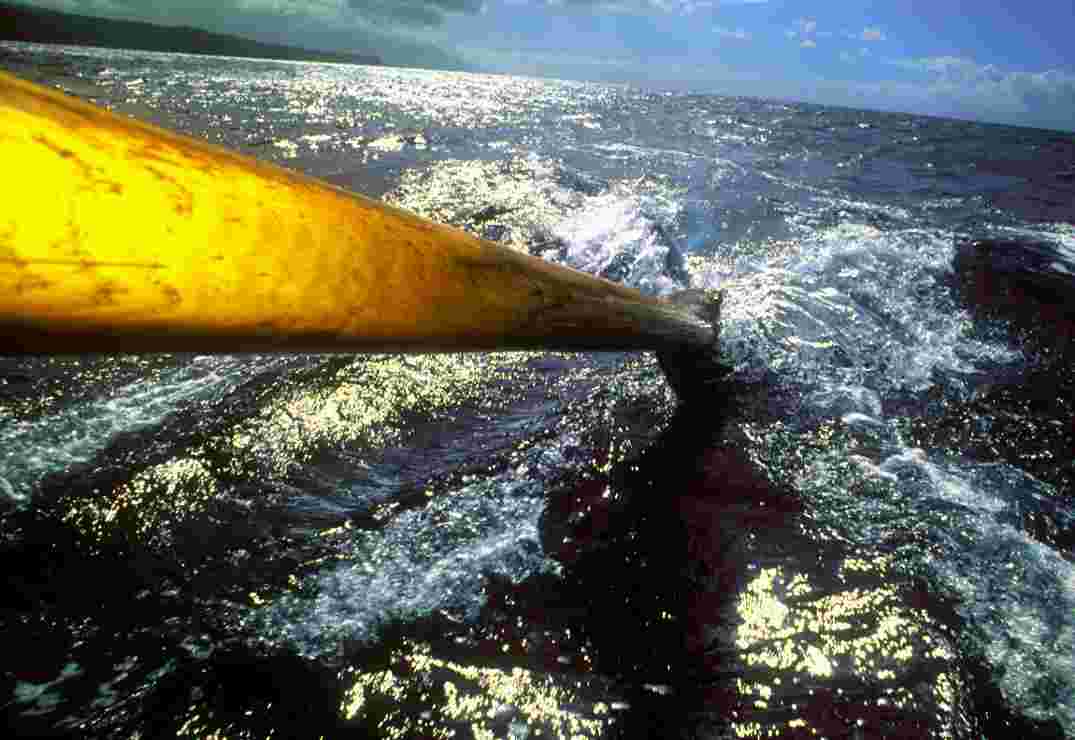 With this command from the watch captain, I join two other sailors wrestling
a massive steering paddle to bring Höküle'a off the chilly, twenty-five-knot
wind that slices across our port bow. Rain sweeps the canoe's decks and
cascades off her sails. We are now living in our heavy-weather gear -
working, eating and sleeping fully encased in glossy yellow Patagonia
slickers. Completing our watches, we seek the shelter of our cramped,
damp berths in one of Höküle'a's hulls and try to sleep, grateful for
the respite from the cold wind and the cry of "sweep!" It is September
29, the seventh day of our journey, and so far we have experienced continuous
strong winds and heavy seas. With this command from the watch captain, I join two other sailors wrestling
a massive steering paddle to bring Höküle'a off the chilly, twenty-five-knot
wind that slices across our port bow. Rain sweeps the canoe's decks and
cascades off her sails. We are now living in our heavy-weather gear -
working, eating and sleeping fully encased in glossy yellow Patagonia
slickers. Completing our watches, we seek the shelter of our cramped,
damp berths in one of Höküle'a's hulls and try to sleep, grateful for
the respite from the cold wind and the cry of "sweep!" It is September
29, the seventh day of our journey, and so far we have experienced continuous
strong winds and heavy seas.
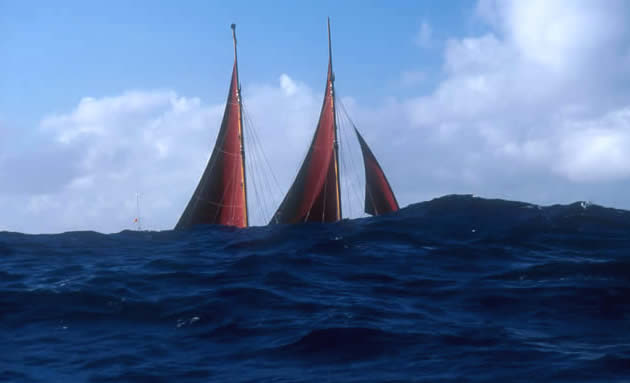
Hokule'a enroute to Rapa Nui
This is not her normal sail plan - the Marconi style has been used because of the need for performance and safety durng the up-wind voyage.
"This voyage will test you," Nainoa had warned us a few days before our
departure. "It will test you physically, mentally and spiritually."
Any voyage without instruments is, of course, extremely difficult, but
this one is especially tricky. On all their previous journeys, Nainoa
and the other navigators have always been able to aim their canoe at a
broad chain of islands. Tahiti, for example, is part of a chain that stretches
across some 400 miles of ocean' a kind of navigational safety net. But
on this voyage, there is no net. Rapa Nui stands alone.
We had expected the southeast tradewinds that blow steadily in this part
of the Pacific to be the greatest challenge of all, forcing us to tack
constantly. But so far we have experienced a kind of miracle - the winds
have blown from every direction but southeast. They have been strong from
the north, west and south, allowing us to proceed east at speeds sometimes
in excess of seven knots. If this keeps up, we will be in the vicinity
of Rapa Nui within a week.
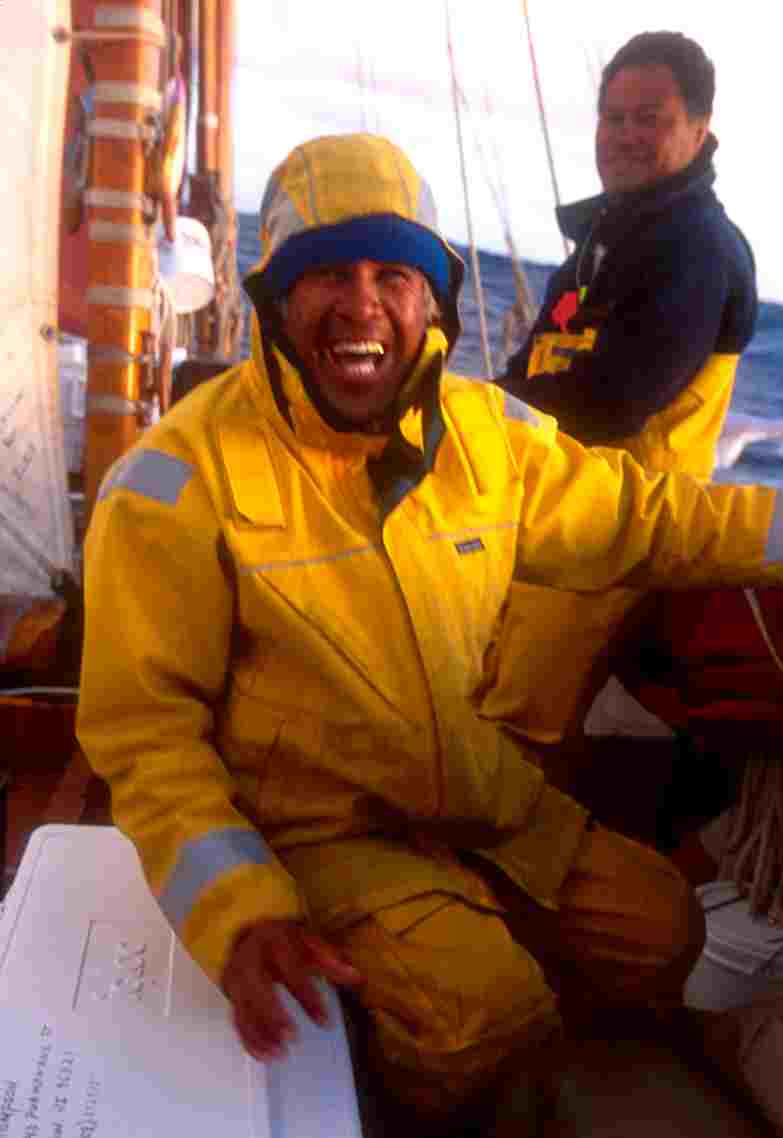 Having traveled more than a thousand miles toward our objective, we are
jubilant - but silent. We don't talk about our good fortune lest we break
the spell. How long can it last? Having traveled more than a thousand miles toward our objective, we are
jubilant - but silent. We don't talk about our good fortune lest we break
the spell. How long can it last?
As we continue east we encounter squalls and heavy seas, but the canoe
rises easily over the swells, channeling tons of water cleanly between
her hulls. She seems alive - responding to the forces of nature as she
was designed to, a testament to the genius of our ancestors. Contemplating
the almost otherworldly grace of this wonderful seagoing machine, I reflect
back on an event that had almost spelled her doom.
It was in May of 1997. Anticipating the rigors of our voyage, Nainoa had
hired a marine surveyor to inspect Höküle'a. After so many ocean miles,
was she still seaworthy? The surveyor laid his hands on the canoe, seeking
imperfections in her outer skin. With a penknife, he probed for dry rot.
He banged on the hull with a rubber mallet, listening for discordant notes.
Finally, after many hours, he made his report.
"The canoe is rotten," he said. "I cannot certify her seaworthiness. I
suggest you think about putting her in a museum."
The pronouncement came as a surprise, but not a exactly a shock. Nainoa
had seen places where there was rot and structural damage, but Höküle'a
had taken him safely across immense ocean distances. Far more than just
demonstrating her seaworthiness, she had shown her mana, her strength
of spirit. Retiring her to a museum was not an option.
"OK, I need two lists," Nainoa said to the surveyor. "I need a list of
what's wrong and a list of what we have to do to make her stronger than
when she was built." The list was long and the repairs expensive. But
in 1998, after a long stay in dry dock, the expenditure of $100,000 and
the gift of some 5,000 hours of volunteer labor, Höküle'a took to the
sea once again. The surveyor returned and qualified her sound in every
respect. In the process, the canoe had been thoroughly refitted for the
Rapa Nui voyage. Her hulls had been lightened and made more efficient,
and special sails had been designed to help her point into the wind. "This
canoe has mana for many reasons," Nainoa said of this remarkable rebirth.
"But one of the most important is the care that so many people have given
to her, the literal laying on of thousands of hands, that has given Höküle'a
new life time and time again."
On October 1, our ninth day at sea, the winds die. The ocean turns to
satin, disturbed only by the deep southwest swell that has been our
constant companion. A serene, crystalline sky encircles us. At night
we steer by Jupiter and Saturn rising ahead, bright as tiny moons, and
Scorpio behind us, her deadly sting high in the sky. Within the dark
stain of night, in light winds, we sail with painful deliberation -
perhaps a mile and a half every hour - toward Rapa Nui.
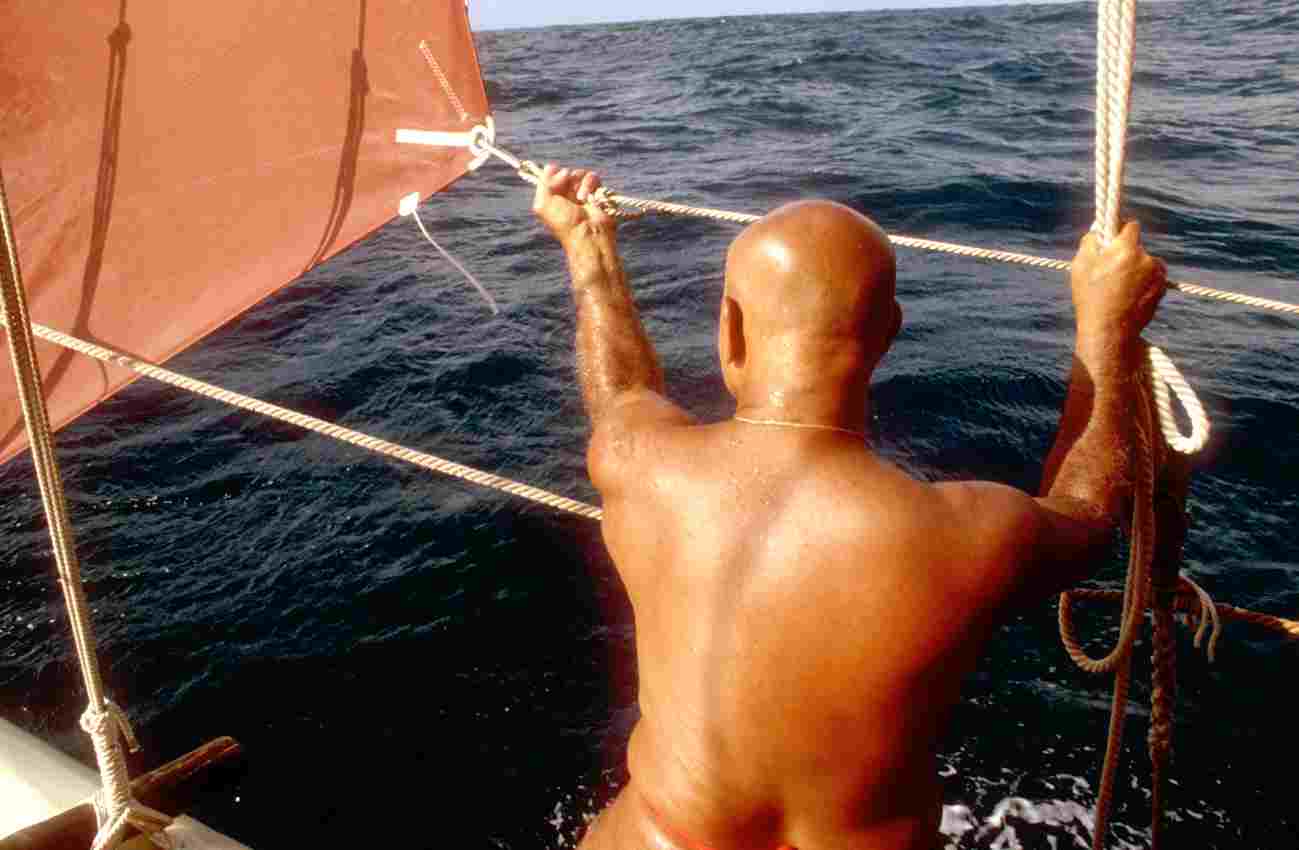 For the next five days the wind flukes around, forcing us into a weaving
dance. When it shifts southeast, we respond by moving north, away from
our target; when it swings northeast, we slant south again. Squalls
descend, bathing us in cold rains and pushing the wind up to twenty-five
knots. Nainoa forms a plan: We will sail southeast to the latitude of
Rapa Nui and then begin tacking northeast in a search pattern intended
to keep the island within the enclosing triangles of our motion until
we find it. On the evening of October 7, he figures we are at Rapa Nui's
latitude and about 175 miles west of it. He wants to sail further southeast,
then tack northeast, beginning our search. But the wind curves north,
stymieing us. Conferring with the other navigators, Nainoa decides to
gamble. We will abandon the careful search pattern and sail due east
- directly toward where he thinks the island should be. But for two
days we have had no star sights because of the overcast sky, and our
position is known only by dead reckoning. What if we have misjudged
our latitude? What if we sail past the island?
For the next five days the wind flukes around, forcing us into a weaving
dance. When it shifts southeast, we respond by moving north, away from
our target; when it swings northeast, we slant south again. Squalls
descend, bathing us in cold rains and pushing the wind up to twenty-five
knots. Nainoa forms a plan: We will sail southeast to the latitude of
Rapa Nui and then begin tacking northeast in a search pattern intended
to keep the island within the enclosing triangles of our motion until
we find it. On the evening of October 7, he figures we are at Rapa Nui's
latitude and about 175 miles west of it. He wants to sail further southeast,
then tack northeast, beginning our search. But the wind curves north,
stymieing us. Conferring with the other navigators, Nainoa decides to
gamble. We will abandon the careful search pattern and sail due east
- directly toward where he thinks the island should be. But for two
days we have had no star sights because of the overcast sky, and our
position is known only by dead reckoning. What if we have misjudged
our latitude? What if we sail past the island?
"This wind is a gift to go east," Nainoa explains, "so I say let's go.
It's scary, but it's exciting. If our dead reckoning is good, and I
think it is, we should take the chance."
Near dawn on October 8, Nainoa stations Micronesian crew member Max
Yarawamai - whose ability to see islands at a great distance is legendary
- at the bow. Ahead, the horizon is totally obscured by clouds, except
for two slim holes. Max probes the one to starboard - nothing. Then
he focuses on the one to port and sees a hardness there, a flat surface
that does not change.
"There it is!" he yells. "Rapa Nui!"
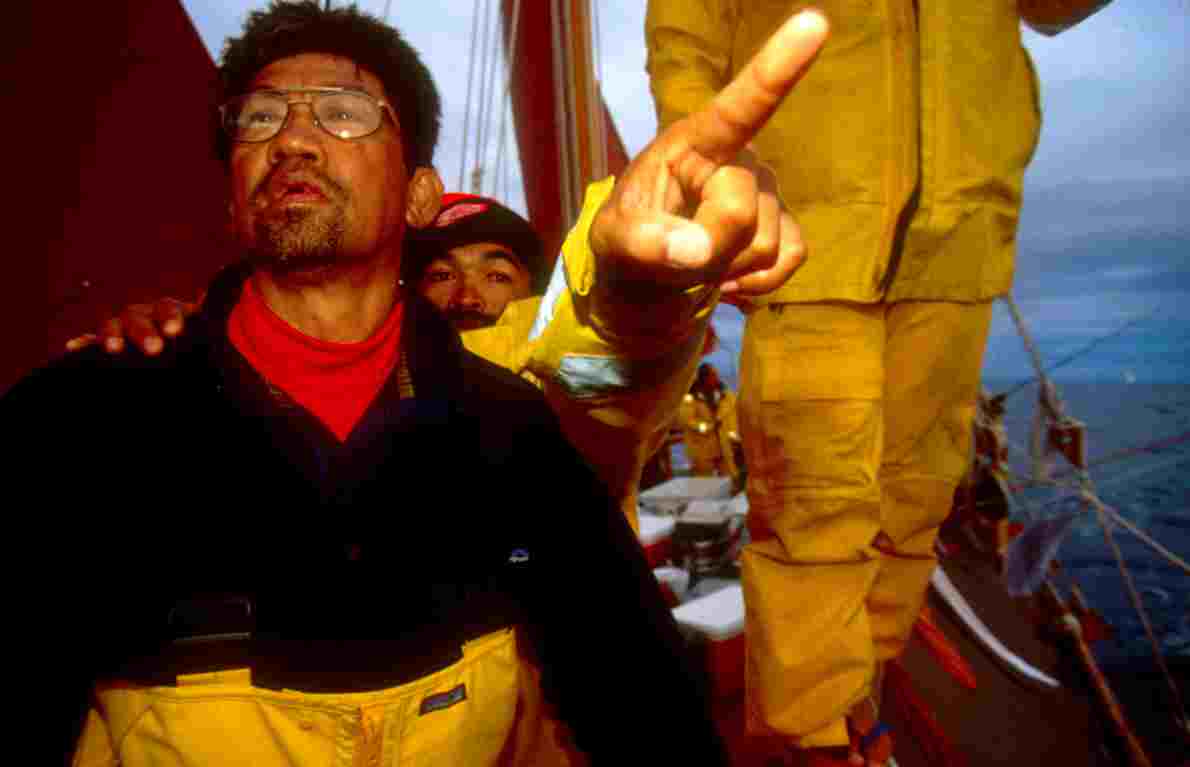
Max
points out Rapa Nui to crewmember Aaron Young
Nainoa sees the flat shape too, but it looks like nothing he remembers
from his previous trips to Rapa Nui. "At first, I was more concerned
with searching behind us to be sure we had not passed the island in
the night," he later explains. "Then, when I saw what Max was pointing
to, the shape seemed wrong. Finally, I realized that we were seeing
just a tiny part of it - the flat place near Rapa Nui's southern caldera,
Rano Kau." Soon the entire crew is on deck, staring at the island off
our port bow. Nainoa climbs the mast and stays there for a long time.
When he comes down, tears streak his face. After breakfast, he calls
us to a meeting. We stand in a silent circle, listening to his words.
"The voyage is pau, and this gives me almost an empty feeling," he tells
us. "But everyone should be proud of this accomplishment. We have traveled
to the last corner of the Polynesian Triangle, and that achievement
is not just ours - it belongs to everyone who has put their heart and
soul into this canoe over the last twenty-five years."
"The wind brought the canoe here," he continues. "It's about mana. Höküle'a
has latent, sleeping mana when she is tied up to the pier in Honolulu.
But when the canoe is sailed by people with deep values and serious
intent, the mana comes alive - she takes us to our destination."
When it becomes obvious that we do not have enough time to reach the
anchorage at the main village of Hanga Roa before nightfall, we are
relieved - happy to have one more evening at sea. The wind is warm and
gentle. The sky, having cleared by mid-day, remains clear into the night.
We sail along the coast of Rapa Nui, some distance away, until the ten
p.m. watch change, when we tack toward the island.
In the morning, we glide close ashore, watching wisps of cloud surge
from Rano Kau. Ivory breakers rim the seam between cold black cliffs
and the gray-blue ocean. From the harbor, boats come out to greet us.
After only eighteen days, a fraction of the time we thought the passage
might take, a voyaging canoe has once more arrived at the easternmost
frontier of Polynesian civilization.
We have traveled so fast, in fact, that we have arrived ten days before
our own welcoming committee - a contingent of Hawaiian dancers and chanters
who are scheduled to participate in a massive celebration. While we
wait for their arrival, we spend our days preparing the canoe for the
next step in her voyage: the passage to Tahiti en route back home.
On the evening of October 18, we take to the sea again to sail to Anakena,
a white strand of beach where Rapa Nui's mythical discoverer, the Polynesian
king Hotu Matua, is thought to have landed. Sunrise reveals eroded cinder
cones and calderas spilling toward a sharp slash of surf at Anakena.
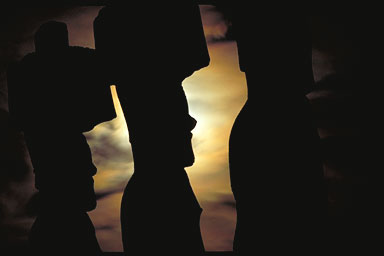
We see the moai - the enigmatic statues that are the globally recognized
icons of Rapa Nui's ancient civilization - standing tall over a prehistoric
temple. A large crowd of maybe a thousand people, one third of the island's
population, awaits us.
On a promontory overlooking the beach, we gather at a triangular ahu
(stone altar) that has been painstakingly built for the occasion by
a tall Rapa Nui man whom most of us know simply as "Carlos." Many of
us met him in 1995, when he voyaged with the fleet of canoes that sailed
from the Marquesas to Hawai'i.
"I have been waiting for this day to arrive," he says in greeting. "I
always knew that you would come."
We have brought three stones from Hawai'i, symbolic of the spirit of
our 'äina, the sacred Hawaiian earth from which we set out. Now we place
them on the northwest corner of Carlos' temple, which is shaped to represent
the Polynesian triangle, and with this gesture we signal a reunion between
our two people, a joining once again of Polynesian families.
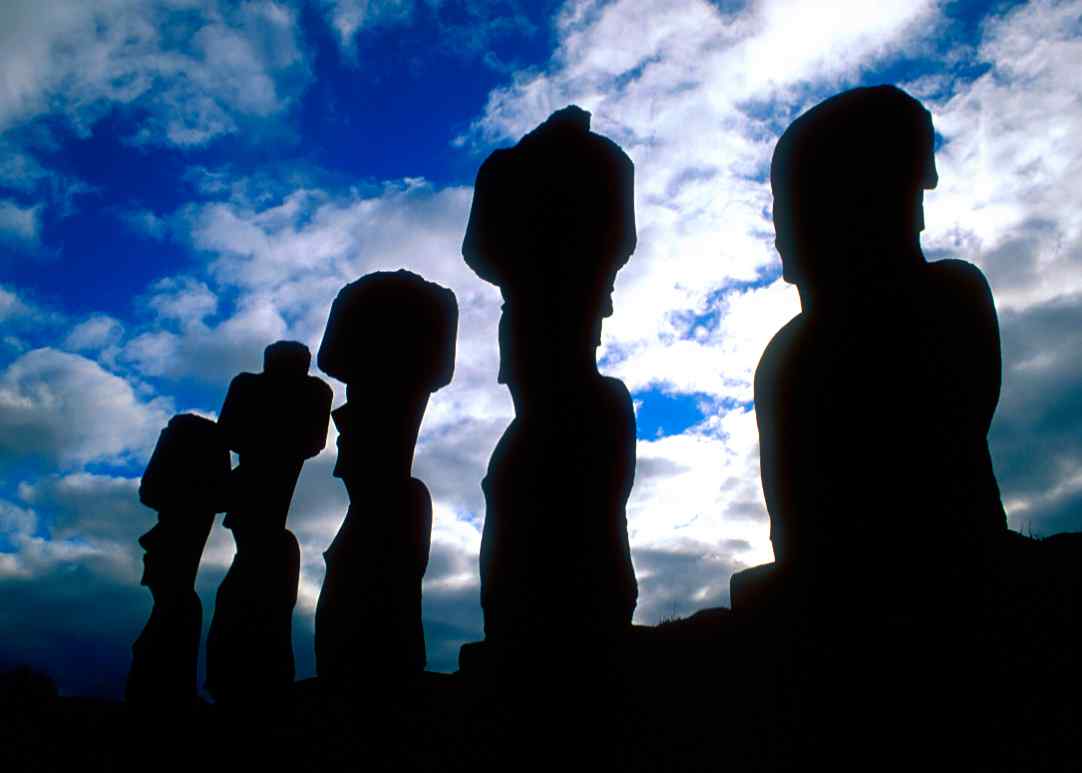
Moai
at Rapa Nui - Sam Low Photo
October 21. On this, my last day on the island, I sit on a ledge of rocks
down by the harbor in Hanga Roa, lost in a reverie. As I listen to the
waves crash on the reef offshore, I remember the excitement of sighting
Rapa Nui and the inner peace of the evening before our arrival, as Höküle'a
ghosted along the coast. We had all lingered on deck, enjoying the last
few moments of comradeship with each other and our canoe. Hotu Matua and
his men must have seen what we were seeing - the dark smudge of the island
against a backdrop of stars - and they must have heard what we were hearing:
the rush of wind over sails, the soft lap of waves on twin hulls, the
murmur of sailors as they sit shoulder to shoulder, waiting for the first
scent of land to reach them.
Our feelings had been mixed. We were proud of our accomplishment, yet
there was also a sharp edge of sadness. For a short time we had been privileged
to share the tiny world of the canoe with each other. Surrounded by an
immense sea and forced to turn inward, we had discovered a harmony within
ourselves and with the natural world. For all of us, this voyage had been
a rare gift of mana. |